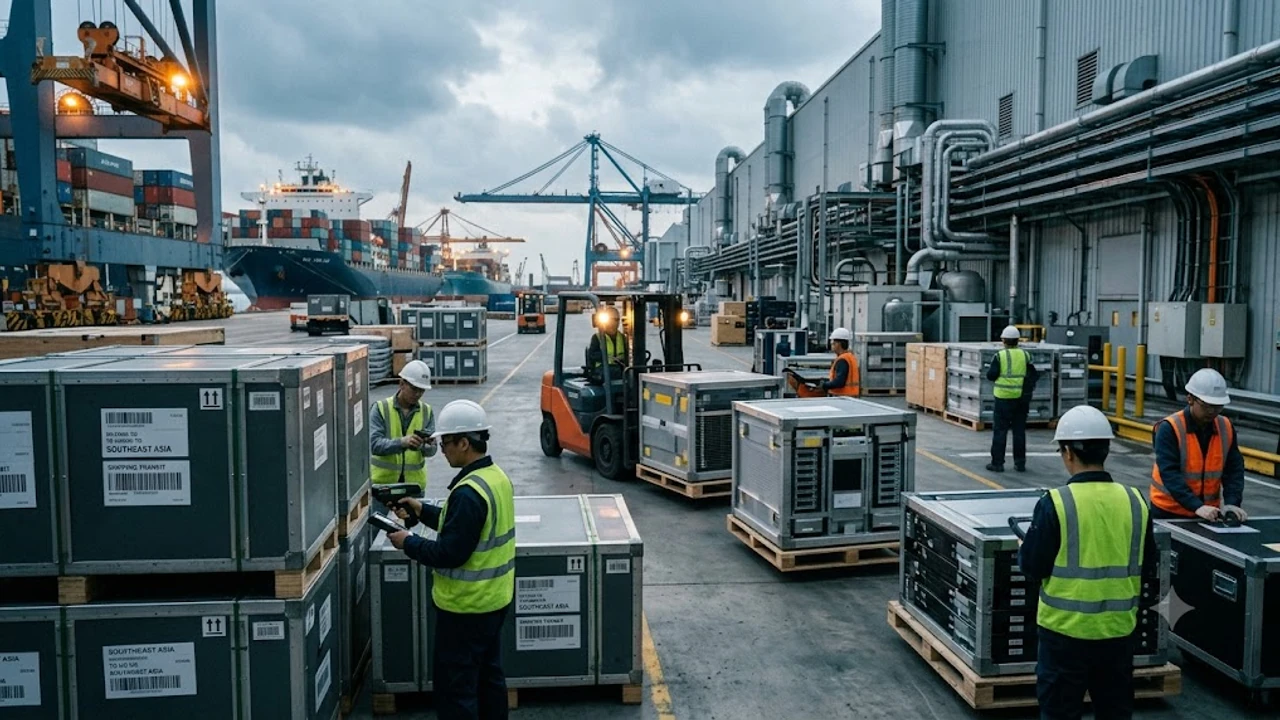
Physical AI has rapidly emerged as the defining technology trend of 2026, shifting the global tech landscape away from simple text-based conversational models toward intelligent, embodied automation. As industries scale these capabilities, the transition to Cloud 3.0 is fundamentally restructuring how infrastructure manages real-world environments. This guide breaks down how these technologies operate, their impact on global supply chains, and the strategic positioning of hardware-heavy economies like South Korea.

Physical AI in 2026: The Shift from Chatbots to Autonomous Hardware
What is Physical AI and Why It Dominates Mid-2026
Physical AI represents the merger of advanced generative models with physical actuators, sensors, and mechanical systems. Unlike traditional software automation that relies on fixed, pre-programmed code, systems powered by this technology can interpret unstructured environments in real-time. For instance, an autonomous warehouse drone equipped with a multimodal foundational model can instantly recognize a damaged shipping crate, assess the safety risk, and re-route its path without human intervention. By mid-2026, enterprise investment has shifted heavily toward these systems because they bridge the gap between digital intelligence and physical labor productivity.
Cloud 3.0 vs. Cloud 2.0: The Evolution of Intelligent Orchestration
The architectural foundation supporting enterprise software has undergone a major paradigm shift. To understand this transition, it is helpful to look at the architectural differences across cloud generations:
| Cloud Generation | Primary Infrastructure | Core Operational Model |
|---|---|---|
| Cloud 1.0 (Legacy) | On-premise to Virtual Machines | Manual scaling, fixed servers, basic database hosting. |
| Cloud 2.0 (Recent) | Containers & Microservices | API-driven, continuous integration, centralized data lakes. |
| Cloud 3.0 (2026+) | Decentralized AI Orchestrators | Autonomous resource allocation, edge intelligence, self-healing code. |
While Cloud 2.0 focused on connecting distinct software applications through APIs and centralized data lakes, Cloud 3.0 introduces decentralized AI orchestrators. Under Cloud 3.0, the infrastructure does not just host code; it continuously writes, tests, and optimizes its own operational parameters based on environmental feedback from the edge.
Key Drivers Behind the Global Enterprise Adoption
Global labor shortages and escalating operational costs are driving corporate adoption at a record pace. According to a June 2026 supply chain resilience report, international logistics firms faced an average 14% deficit in skilled warehouse operators over the past year. Furthermore, the massive computing power required to run real-time translation and spatial reasoning at the edge has become cost-effective due to new neuromorphic chip architectures. Companies are no longer deploying AI to simply answer customer emails; they are deploying it to prevent physical bottlenecks on factory floors.
Core Industry Impact: Smart Factories, Robotics, and Logistics

How Physical AI Automates Heavy Industry Supply Chains
Heavy industries are experiencing a profound transformation as autonomous hardware moves from isolated testing zones to integrated production floors. In major shipping ports, autonomous gantry cranes now utilize spatial AI to dynamically balance cargo loads under severe weather conditions. These systems do not rely on a fixed script; they evaluate wind velocity, maritime telemetry, and real-time structural stress to adjust their hoisting vectors. This reduces transit delays by optimizing container placement workflows automatically.
The Rise of Self-Healing Software and AI Cloud Orchestrators
One of the most valuable aspects of Cloud 3.0 infrastructure is its self-healing capability. When an unexpected system anomaly occurs—such as a localized network failure or an API timeout—the AI cloud orchestrator does not trigger a standard error log for a human engineer to fix.
“Modern Cloud 3.0 systems isolate the failing microservice, analyze the root cause using integrated diagnostic models, generate a software patch in a sandbox environment, and deploy it within milliseconds.”
This continuous, automated maintenance eliminates costly operational downtime in critical systems like municipal power grids and automated fulfillment networks.
Real-World Case Studies of Global Tech Leaders
Major global enterprises are demonstrating the measurable benefits of this technology. For example, a leading multinational logistics firm recently integrated an advanced spatial AI orchestration platform across its European fulfillment hubs. The company reported a 22% increase in sorting throughput alongside an 18% reduction in mechanical wear-and-tear. By allowing the AI to adjust conveyor speeds dynamically based on incoming package volume and weight distribution, the system prevented the mechanical friction common in traditional fixed-speed operations.
The Korean Connection: Leading the Global Hardware Evolution
South Korea’s Conglomerates: Samsung, Hyundai, and Doosan
South Korea is uniquely positioned to capitalize on the rise of embodied AI because of its massive, world-class hardware manufacturing ecosystem. Domestic conglomerates are aggressively embedding intelligence into their core physical products. Samsung Electronics is integrating advanced neural processing units directly into industrial sensor arrays, while Hyundai Motor Group has accelerated the deployment of autonomous mobile robots within its manufacturing facilities. Doosan Robotics has similarly expanded its lineup of collaborative arms that feature real-time force feedback loops, allowing them to perform intricate assembly tasks safely alongside human workers.
How Korean Smart Factory Initiatives Align with Cloud 3.0
The South Korean government’s long-term smart factory initiatives are merging with the distributed architecture of Cloud 3.0. Industrial complexes in cities like Ulsan and Changwon are upgrading their infrastructure to support high-bandwidth, low-latency edge computing. This localized computing power allows factories to process massive streams of telemetry data right on the factory floor. Instead of sending raw data to centralized servers abroad, these smart factories utilize local AI models to adjust precise manufacturing tolerances on the fly, ensuring minimal material waste.
Pros and Cons of Korea’s Tech Infrastructure for AI Scaling
Evaluating South Korea’s position reveals distinct structural trade-offs that will dictate its long-term competitiveness in the global market.
Advantages:
- Unrivaled Hardware Integration: Korea possesses an exceptional semiconductor and precision-machinery ecosystem, allowing rapid prototyping of physical robots.
- Ultra-High-Speed Connectivity: The nationwide 5G-Advanced and early 6G testbeds offer the low latency necessary for real-time edge orchestration.
- Unified Corporate Ecosystems: Large conglomerates can test new tech seamlessly across their own supply chains, from chip production to automotive assembly.
Disadvantages:
- Software Talent Deficit: Korea continues to face a shortage of high-level AI cloud architects compared to Silicon Valley.
- High Regulatory Barriers: Strict data-privacy and labor regulations can slow down the deployment of fully autonomous systems in public spaces.
- Dependence on Global Foundations: Most base LLMs and foundational spatial models are still designed by Western tech giants, leaving local firms reliant on external software licenses.
Complete Guide to Preparing Your Business for the Cloud 3.0 Era
Step-by-Step Blueprint for Enterprise AI Integration
Adapting an existing enterprise architecture to leverage Cloud 3.0 requires a systematic, phased methodology to mitigate deployment risks.
- Conduct a Data and Sensor Audit: Document all physical assets, legacy IoT sensors, and data streams to ensure they can output clean telemetry.
- Upgrade to Hybrid Edge Infrastructure: Deploy localized edge computing nodes near your physical operations to reduce latency for critical AI inferences.
- Implement Decoupled Orchestration: Transition your software architecture away from rigid monolithic APIs toward flexible, AI-managed microservices.
- Deploy Continuous Feedback Loops: Establish a secure sandbox environment where autonomous models can test operational changes before hitting production.
Essential Tools and Infrastructure Upgrades Required
Upgrading to this new paradigm requires specific hardware and software investments. Legacy servers cannot handle the parallel processing demands of continuous spatial reasoning. Businesses must invest in specialized AI accelerators at the edge, alongside distributed data frameworks designed for real-time streaming data. On the software side, engineering teams must become proficient with autonomous orchestration platforms that utilize declarative configurations, allowing the AI to determine the best path to reach a desired operational state.
Future Outlook: What to Expect Beyond 2026
Looking toward the late 2026 horizon, the boundary between digital software and physical infrastructure will grow increasingly faint. As foundational models become smaller and much more efficient, we will see highly localized intelligence embedded into everyday industrial components, from individual hydraulic valves to autonomous transport containers. Organizations that build the structural flexibility to adopt Cloud 3.0 infrastructure today will secure a major, compounding efficiency advantage over competitors stuck relying on manual, static cloud workflows.
함께 읽으면 좋은 글
- 2026 AI Agents Guide: Why Your Business Must Adapt Now
- AI Inference Cost Crisis: 2026 Hybrid Cloud Strategy
#PhysicalAI #Cloud3 #TechTrends2026 #SmartFactories #Robotics #EnterpriseTech #GlobalEconomy #SouthKoreaTech #Automation